Bangladesh's dedicated specialist in world-class seismic isolation technology. LRB, FPB & HDRB bearings — proven on Padma Bridge, now available for your building.
We personally visited and documented Bangladesh's only active base isolation project — Fire Service HQ, Mirpur. No other company has this direct knowledge.
We work with an internationally certified bearing manufacturer holding CE, ISO and EN 15129 compliance, with an established export record. Full certification and project references shared during technical evaluation.
Submit your structural drawings and receive a complete bearing design with FOB quotation within 5–7 working days — at zero cost to you.
All products meet Bangladesh National Building Code 2020 requirements. We provide full technical documentation for RAJUK submission and structural engineer review.
From concept to installation — technical advisory, remote video installation guidance, after-sales support, and BNBC-compliant calculation sheets included.
We work on manufacturer FOB pricing with full cost transparency. Every project we register is handled through a single channel — no duplicate quotations, no confusion.
Custom-engineered for each project. Submit drawings for exact specifications and pricing.
The world's most widely used seismic isolator. Alternating rubber and steel layers with a central lead core extend the building's natural period and dissipate seismic energy, typically cutting the force reaching the structure by 60–80%.
Used on Padma Bridge — designed to withstand 8.5 magnitude earthquakes. Pendulum physics provide self-centering after seismic events.
Natural rubber compound with high intrinsic damping — no lead core required. Excellent for buildings where lead-free solutions are preferred.
Bangladesh National Building Code 2020 officially recognizes base isolation and divides the country into four seismic risk zones.
| Zone | Risk Level | Z Value | Key Cities |
|---|---|---|---|
| Zone I | Low | 0.12g | Khulna, Barisal, Rajshahi |
| Zone II | Moderate | 0.20g | Dhaka, Faridpur, Jashore |
| Zone III | Severe | 0.28g | Chattogram, Rangpur, Narsingdi |
| Zone IV | Very Severe | 0.36g | Sylhet, Mymensingh |
Source: BNBC 2020 / BUET Research 2025
RAJUK's 2018 survey of 204,106 buildings found 66.1% violated building codes. RAJUK's own member says the real figure is closer to 95%.
For the first time, Bangladesh's national building code includes design provisions for base isolation and energy dissipation devices — giving engineers a formal basis to specify the technology.
Epicentred on the Shillong Plateau, this quake devastated Sylhet and the surrounding region. The same fault system remains active today.
Bangladesh had no dedicated seismic isolation supplier. We are the first — bringing manufacturer-direct pricing and full technical support to the market.
A magnitude 7.4 earthquake struck western Colombia at 7:34 in the morning —
the country's strongest recorded quake of this century. The epicentre was in
San José del Palmar, a thinly populated area of Chócó province,
around 400 km from Bogotá, at a depth of roughly 79–107 km.
Yet most of the deaths were not near the epicentre. They were 150 to 250 km away,
in the valley cities of Pereira, Cali and Manizales.
A deep earthquake should lose much of its energy before reaching the surface. Seismologists noted
that this one, despite its depth, still produced severe shaking — and it did so most violently
in cities built on soft valley sediment far from the source. Pereira recorded around 60 deaths and a
seven-storey building came down in its central plaza. Cali reported dozens of collapsed structures
and scores of people missing. The epicentral province itself, though badly hit, was not where the
worst of the toll fell.
That is the same geometry Dhaka faces. The Madhupur Fault lies roughly 60 km away; Dhaka sits on
soft alluvial deposits and filled wetland. Distance from a fault is not safety when the ground
beneath a city amplifies whatever arrives.
Sources: US Geological Survey · Colombian Geological Service · Colombian Association of Capital Cities · CNN, Reuters and CBS News reporting, 10–11 August 2026. Casualty figures were still rising at the time of writing and magnitude and depth estimates differed between agencies.
Two earthquakes struck northern Venezuela 39 seconds apart — magnitude 7.2, then 7.5. In the coastal state of La Guaira, 80% of buildings collapsed. The buildings did not fail because the earthquake was unsurvivable. They failed because they were never designed to move.
A conventional building is designed to resist an earthquake — it absorbs the force through damage to its own columns and beams. A base-isolated building is designed so the force never fully arrives. The isolation layer lets the ground move underneath while the structure above stays comparatively still, typically cutting the force reaching the building by 60–80%. This is why hospitals, emergency headquarters and data centres worldwide are increasingly built on isolators: they must remain operational the day after, not merely standing.
Sources: USGS · Britannica · CNN · ReliefWeb · World Vision, reporting on the 24 June 2026 Venezuela earthquake sequence. Figures as reported August 2026 and subject to revision.
On 21 November 2025, a magnitude 5.7 earthquake struck
Madhabdi in Narsingdi — just 33 km from Dhaka. The shaking lasted 26 seconds.
In Dhaka, roofs and walls came down and building railings fell into the street.
Six people died and around a hundred were injured.
That was a moderate earthquake, at a distance. The studies below describe what a real one would do.
No published study models an epicentre directly beneath Dhaka — the scenarios above assume the Madhupur Fault in Tangail, roughly 60 km away, or a source within 100 km. A magnitude 6 originating under the city itself would deliver its energy at close range, with far less distance for the shaking to weaken before it arrives. Soft soil would then amplify what reaches the surface. The relevant question for any new building in Dhaka is not whether the ground will shake, but whether the structure has any mechanism to keep that shaking out.
Sources: RAJUK seismic risk study presented at the Institution of Engineers, Bangladesh (2025) · JICA–CDMP Dhaka earthquake scenario · Bangladesh Meteorological Department reporting on the 21 November 2025 Narsingdi earthquake · Prof. Mehedi Ahmed Ansary, BUET. Projections are modelled estimates and vary by assumption.
Short videos explaining the technology and showing what earthquakes do to buildings that lack it.
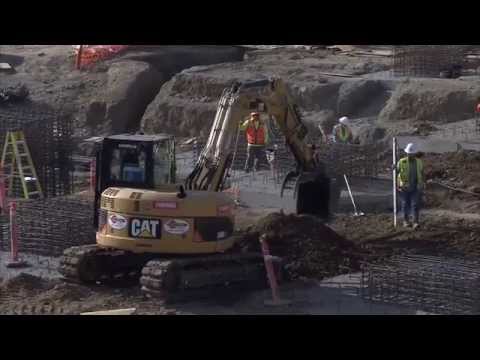
Base isolation is new to Bangladesh, and almost no one selling it here has watched it go in. We visited the country's first base-isolated building during construction — the Fire Service and Civil Defence headquarters in Mirpur, a Public Works Department project built with Japanese ODA financing — and followed the isolators from delivery through installation.
Photographs taken during site visits by Seismic & Trading (OPC). We were present as visitors to observe and learn from the installation. We were not the supplier, contractor or consultant on this project.
Base isolation is not a future technology — it is already protecting Bangladesh's most critical infrastructure.
Bangladesh's first base-isolated building. Personally visited and documented by our team during active LRB installation. Supervised by JICA and PWD, constructed by TOA Corporation of Japan.
Friction pendulum bearings designed to withstand an 8.5 magnitude earthquake. The same category of technology is now available for buildings through Seismic & Trading OPC.
Bangladesh–China Friendship Exhibition Center in Purbachal — a China-aided project incorporating seismic isolation bearings, further evidence that the technology is already entering Bangladesh's major public buildings.
Our commission-based model means you get factory prices with full local support — no markup middlemen.
Share your structural drawings with us — free of charge, no obligation.
Our manufacturer designs the exact bearing specification for your project in 5–7 days.
Receive factory-direct pricing. You add local logistics — total transparency.
30–60 days production and shipping to Chittagong port after order confirmation.
Remote video guidance + full technical documentation. We stay with you through completion.
Send us your structural drawings and get a free bearing design + quotation within 7 working days.
Bangladesh's dedicated specialist in seismic isolation bearing systems. Submit your project details and we'll respond within 24 hours.